Chapter 5: Getting Closer and Closer
Math Problem Set
1. Numerically determine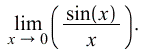
![LeftSide := [-0.1e-1, -0.1e-2, -0.1e-3];](images/Maple 19 SVDiff Calc Document Solutions_425.gif)
![LeftSide := [-0.1e-1, -0.1e-2, -0.1e-3];](images/Maple 19 SVDiff Calc Document Solutions_426.gif) |
(5.1.1) |
![RightSide := [0.1e-1, 0.1e-2, 0.1e-3];](images/Maple 19 SVDiff Calc Document Solutions_427.gif)
![RightSide := [0.1e-1, 0.1e-2, 0.1e-3];](images/Maple 19 SVDiff Calc Document Solutions_428.gif) |
(5.1.2) |
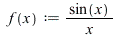
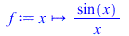 |
(5.1.3) |

![[.9999833334, .9999998333, .9999999983];](images/Maple 19 SVDiff Calc Document Solutions_432.gif) |
(5.1.4) |

![[.9999833334, .9999998333, .9999999983];](images/Maple 19 SVDiff Calc Document Solutions_434.gif) |
(5.1.5) |




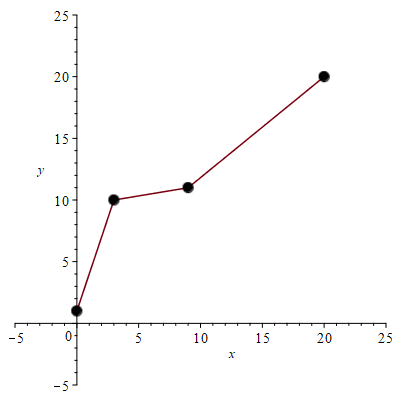


2. Consider  . Does it have a discontinuity? Create a plot. If a discontinuity exists, highlight it on the image.
- 3. Determine
 using the limit() command.
4. Given that 
5. Evaluate the limit or determine that it does not exist. State a reason why. Use a graph to back up all conclusions.
6. Determine what value of the constant ‘ a ‘ makes the function 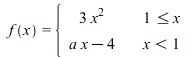 continuous everywhere.
7. Determine the equation of a function where the following conditions are met: 
8. Using the Limit Tutor determine: 

Maple Problem Set